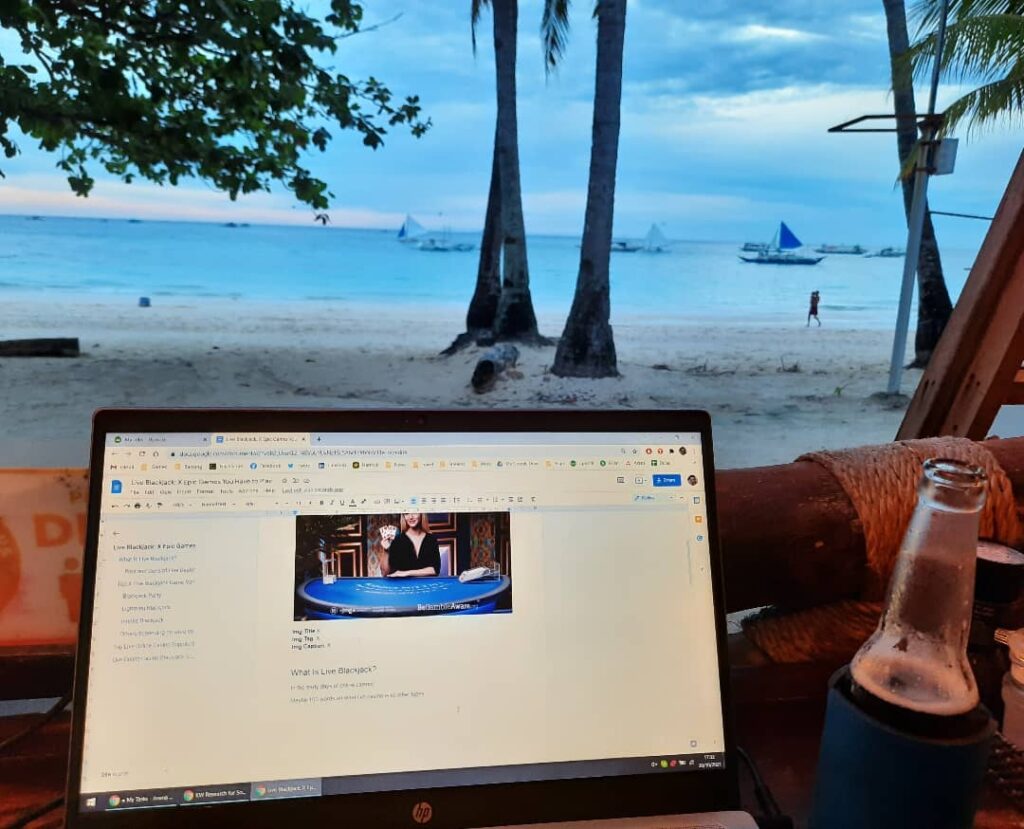
This week’s opportunities for iGaming writers are in
I’m going to move these updates over to my blog for now. But you can still expect a weekly dose of opportunities for iGaming writers.
Here’s what I encountered last week.
Content Lab is hiring! They need freelance gambling writers in multiple languages: Dutch, German, French, Polish, Hungarian, Arabic, Portuguese and Spanish. Email luciana@content-lab.co with samples, rates etc.
As always, ClickOut Media are recruiting. This week, they want a French-speaking SEO content writer for an iGaming project.
Web International Services Ltd posted on LinkedIn about a number of positions, including:
Annie Mercer posted about several roles at Van Kaizen. This included an on-site iGaming content writer in Cape Town, South Africa. Contact annie@vankaizen.com for more information.
I don’t just write about iGaming. I also provide fractional content management services.
I’d never heard anyone use the term “fractional services” until earlier this year. But I’ve actually offered fractional content management – without even realising it – since late 2021.
Let’s talk about it.
Fractional Services Explained
A fractional service provider is essentially a consultant, but more hands-on.
You can recruit experienced professionals on a temporary basis, with no need to commit to expensive, long-term contracts. They do the job as usual, but you can work with them for just a few days, weeks or months at a time.
This gives you better control over your spending and removes a lot of HR-related pain.
There all all kinds of fractional services available. A fractional CMO, for instance, is just like any other Chief Marketing Officer. The only difference is the temporary nature of the arrangement.
What is a Fractional Content Manager?
As you can now guess quite easily, a fractional content manager is a temporary hire that handles your content needs.
They work closely with senior management to plan, create and deliver an overall content strategy. Unlike a freelancer, they are available on-demand, giving you greater flexibility. But you don’t have to pay a salary, or worry about performance reviews and pensions, as you would a full-time employee.
Advantages of Fractional Content
There are many reasons to consider fractional content services, including:
Managing costs. Hiring a fractional content manager allows you to pay as and when required. Why make a full-time hire if you only need assistance for four months?
Better quality. Regular content agencies outsource to lower-paid, lower-skilled freelancers. You have no control over who’s working on your project.
Easy access. Unlike a standard freelancer, you have on-demand access to a fractional content manager. Need something changed urgently? No problem.
Outsourcing admin. A fractional content manager assembles their own team, if required. That saves you the time and effort of recruiting a bunch of freelancers.
So, What About Me?
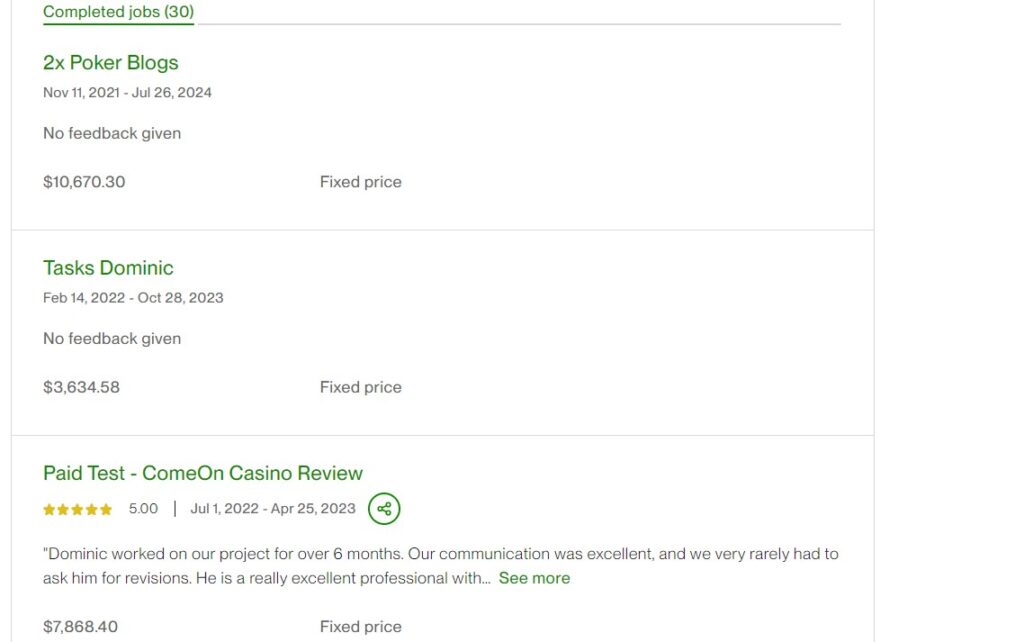
In September 2021, about six months after I turned freelance, I started working with Casino.Zone. I was initially tasked with optimising existing published texts. But I also wrote a bunch of iGaming content, including information about casino software developers and regulatory authorities.
By the end of the year, I was managing most of the content production for Casino.Zone, including slot reviews, live casino game reviews and informational articles. I did this for over a year, before the project was parked, delivering 25-40 pieces a month.
Although I wrote a lot myself, some of it was outsourced to a team of trusted gambling writers. I worked hard to shape them, imposing my own very high standards. All of their content was edited and published by me, so I took full responsibility for everything.
My iGaming content services included:
Planning a content calendar
Keyword and competitor research
Creation and distribution of briefs
Recruitment and management of writers
Proofreading and editing
Writing iGaming content
Sourcing of images
Publishing in the CMS
Early in 2024, I offered a similar service to the Slot Java team, where I produced 30 slot reviews per month.
Need a Fractional iGaming Content Manager?
It turns out that I’ve been offering fractional content services for years, without even realising it had a name.
And I can do the same for you.
If you needing help creating and implementing an iGaming content plan, contact me for a free discussion. Let’s see how I can make your life easier.
In August, I posted on LinkedIn about the about the price of iGaming content, or in other words, how much a gambling writer can earn. Now, I want to follow up on that with an update.
My Pricing History
If you didn’t see the original LinkedIn post, here’s a recap:
The Beginning
When I started writing gambling content, inspired by a 2008 trip to Dublin, I was paid $5 for a 300 word Premier League match report.
I quickly found regular work as a casino writer with a client that paid $0.05 per word. We worked together for around four years.
Part Two
In early 2013, I dropped that side hustle, as my gambling industry career had really taken off. I wouldn’t take any more paid work as an iGaming writer until 2020, when COVID-19 made me reassess my life.
The aim was to start writing again with a comically low rate and build a fresh portfolio, securing reviews that I could use to gain more work. If I got back to $0.05 per word, I’d be happy.
Here’s a timeline of how my rates progressed:
July 2020 – $0.01 p/w
January 2021 – $0.03 p/w
July 2021 – $0.05 p/w
Mission accomplished in just one year. I was back to square one and in a position to quit my job and pivot to freelance writing.
Growing My iGaming Writing Business
I had no idea what other gambling writers were charging at this point. I was just happy to have met my short-term goals.
The next challenge was to grow the business of writing casino, sportsbook and poker content, and really make it pay.
Here’s how it panned out over the next three years:
March 2022 – $0.08 p/w
March 2023 – $0.10 p/w
March 2024 – $0.12 p/w
My first six months of freelancing were surprisingly easy. You know when you think it’s all going too well and it’s bound to come crashing down? Yeah, that.
Regardless, I kept inching my rates up, but the clients kept coming, no matter what the cost. I was starting to believe that I was very good – why else did the work feel easy and the five-star reviews keep rolling in?
That gave me the confidence to keep increasing. Every time a project wrapped up, I’d put a penny on the rate of my Fiverr and Upwork gigs.
Reaching a Plateau
I kept doing this until the start of 2024. By the middle of that year, I’d plateaued at $0.12 per word.
I experimented with $0.14 a few times, but couldn’t get any bites. The closest I got was by accident – an existing $0.12 client voluntarily added a penny on top in order to secure priority content.
October 2024 – a Breakthrough
Given the rising costs of literally everything, I figured it was time for another crack at $0.14 per word in October.
There’s one client in particular that supplies me with a lot of work. It’s an agency and they have plenty of resources behind them. I’ve had nothing but glowing feedback from them for the six months we’ve worked together, so I chanced my arm and asked for a raise. I got it.
With the new benchmark secured, I’ve also increased my rates on freelancing platforms accordingly – though in fairness, I’ve almost completely moved away from them now. I get the odd bits and pieces through Fiverr, while Upwork can go fuck itself.
Obviously, I’d like to think I can. I know I’m one of the best around, as I’m constantly told so. But I have to imagine this is pretty close to the ceiling for this kind of content.
Regardless, by sharing my own pricing journey, I hope to help aspiring betting, poker and casino writers. It certainly can’t hurt to have a clear idea of what you should be getting paid as you start to build your own brand.
I wish I’d had this information to hand earlier in my freelancing journey. If I had, there’s no doubt in my mind that I’d have earned better rates much more quickly than I did.
I’m a much better Upwork detective than I am a graphic designer…
My disdain for Upwork is hardly a secret. Even though I’d prefer people not to use that money-grabbing platform, I know some people still do.
Well, if you’re going to use it, make sure you know the tricks to reduce expenditure.
Today, I’ll share a top tip of mine to help you out. You need to become an Upwork detective.
Check the Client Feedback
The tip is simple. Before bidding, take the time to scour the client’s feedback. More often than not, an unwitting freelancer will have saved you money.
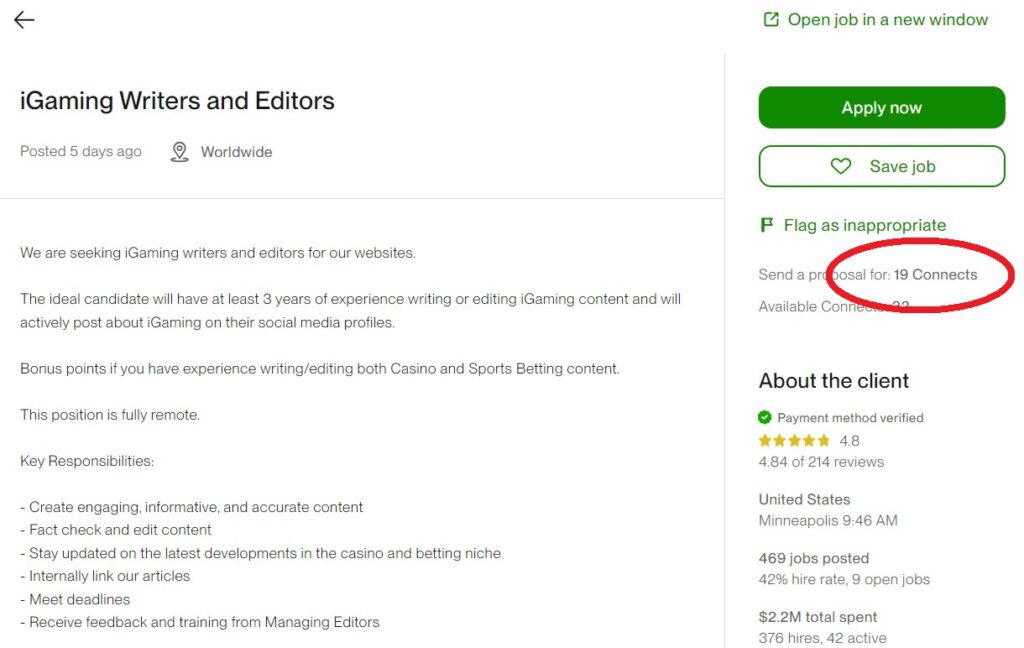
Take this recent Upwork posting, for instance.
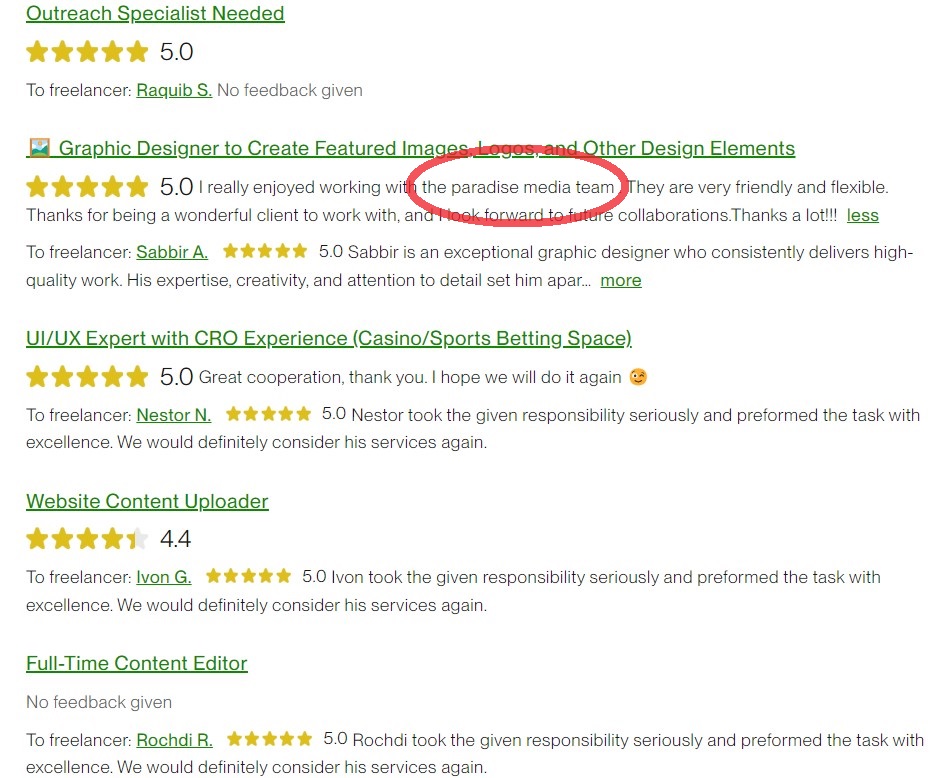
The client is looking for aniGaming writer like me, so naturally, it caught my eye. But if you think I’m paying 19 connects, you can funk all the way off.
Instead, I went trawling through the 214 reviews, panning for gold. Which I found pretty quickly:
Thanks Sabbir!
Now What?
All I have to do now is Google “Paradise Media” and look for their website. You’re always likely to find something like an email address or contact form, if not an entire page full of freelance and full-time opportunities.
No joy? Then look for pages that talk about the company’s employees. There’s always something like an “About Us” or “Meet the Team”.
You’re sure to find someone from HR, talent acquisition or the marketing department. Look up them up on LinkedIn and hey presto, a free application opportunity.
You don’t even have to mention that you found the listing on Upwork. Just send a cold, “speculative” pitch that just happens to be tailored to exactly what they asked for in the original post.
The only thing worse than Upwork is my ability to design images
When I decided to ditch my job in the gambling industry and turn freelance, Upwork unquestionably played a key role in the transition.
Once I’d picked up my first few gigs as a gambling writer, earning five-star reviews, there was no turning back.
However, in the past few years, the site has become an utter clown show. It’s nothing but price gouging and underhand tactics, carefully designed to drain every last penny out of us freelancers – the very people who make the site its money.
Penny Pinching Upwork
Three years ago, I was fully aboard the bandwagon, happily telling anyone who’d listen that Upwork was better than Fiverr, for example. But I noticed it starting to go downhill sometime in 2022.
Here’s a few of the things that upset me, causing me to move away from that money-grabbing platform and work to build my own brand.
Commission Structure
The first change that upset me was a move away from tiered commission. Upwork used to charge 20% when first working with a client, but it was quickly reduced to 10%. Eventually, it fell to just 5% for long-term clients.
Basically, you were incentivised to be good at your job. Provide excellent service and win repeat business and you’ll be rewarded with low commission.
When they chose to make it a flat 10%, it sent a clear message that people like me were no longer appreciated. Instead, they were encouraging newbies to chase a dream, prioritising newcomers over their longest-serving freelancers.
They tried to sell this as a good thing. And for some, it probably was. But given that all of my Upwork clients fell into the 5% bracket at that point, this “benefit” was actually a pay cut for me.
To then tell me it’s a good thing was a massive insult to my intelligence and began to turn me off.
Minimum Connect Fees
Soon after, I started to notice that prices were increasing. I’d never seen a job require more than 16 connects to bid before. Suddenly it was costing almost 30 to apply to work with clients that needed iGaming content.
Today, you can regularly see jobs that require more than 30. It’s too much when you only get 10 free connects per month.
Bidding System
Next up, they introduced the bidding system, designed to pit all of us against each other. My understanding is that this actually used to be the case at Upwork in the past, but this system was removed. You have to ask why they did that, and why they chose to bring it back.
Not content with directly increasing the ceiling on the number of connects, they could now massively inflate prices even more. Desperate freelancers throw every cent they have at jobs, inflating prices on Upwork’s behalf.
Even worse, they openly admitted to using phantom bids to kickstart auctions, as well as “placebo jobs”, where you waste your time applying, only to then be told it’s not a real job.
Admin Fees
General admin fees, such as the contract initiation fee, have skyrocketed in recent years. The most egregious example of this is when they sneakily brought in a fee for accepting contracts from clients approaching you directly.
In the past, if a potential client reached out to the freelancer (as opposed to bidding for the job) then it wouldn’t cost anything to start working together. Now it’s $4.99 to play.
Only, they kept this change quiet, and many freelancers continued to accept work, have their fingers burned and wonder why. The forums were full of complaints.
It’s particularly disgusting to see how they happily exploit people in developing countries. See my LinkedIn post about someone I know in the Philippines. They were charged $5.49 for a $5 Upwork job.
When people say you should give 110%, it’s not meant to be taken literally.
My days as a poker and casino writer on Upwork are finished. These jobs are my last.
What’s the Solution?
Nobody cares about moaning and whining. That’s why I decided to take action.
I no longer accept jobs from Upwork and I’d encourage others to adopt a similar stance. I’ll tell anyone who wants to listen about how crappy the platform is.
If you have to use it, perhaps because you’re just starting out, take full advantage and don’t be afraid to be as unscrupulous as they are. Win a few clients, talk to them off-platform and arrange private payments.
Build Your Own Brand
Put together a portfolio, take Upwork for everything you can and build your own personal brandin the meantime.
The aim should be to get off as quickly as possible, using platforms like LinkedIn and your own website. That’s exactly what I did with my iGaming content services.
Upwork doesn’t care about you. There’s no need for you to care about them and their rules. Treat the platform the same way they treat us. Shabbily.
These bloody things were briefly the bane of my life, but I’ve cut them out entirely for a more stress-free existence as a freelance writer.
Ahead of the AI Curve
At the start of the ChatGPT-fuelled AI hype, I figured I’d better get ahead of the curve. After all, as a freelance iGaming writer, editor and translator, this could be a threat to my livelihood.
What could I do? I figured it would be smart to offer an AI editing service. So I did.
My short-lived Fiverr and Upwork gig to help you beat the AI checkers.
If people want to save money by mass-producing crappy AI-spun content, don’t fight them. Instead, I could offer to improve it for them, adding the humour, nuance or empathy that a robot simply can’t.
Plus, I could also offer to fact check it, since LLMs are always wrong about literally everything, and rewrite it to beat the newly-emerging AI checking tools.
Sounds good, right? LOL.
How it Started
In fairness, this worked pretty well for a few weeks. But then I took on a client who was using Originality.AI, the most egregious of the AI checking pseudoscientists. He asked me to rewrite 2,500 words of content created with ChatGPT. No problem, I thought. Should take about three hours.
I edited, quite literally, every single sentence. After submitting, the client said that Originality was still showing a very high percentage of AI-generated content (I forget the exact figure). Okay, fine. I’ll have another crack.
After rewriting every single sentence a second time, he told me that it was still only 59% human, according to the AI checker.
Strict Conditions
At that point, I decided I would only continue with this service if we set some clear expectations. Firstly, I would never work with Originality.AI again. End of discussion.
Then, I would ask what the client’s expectations were. If they told me they wanted more than 80% human, regardless of the AI checker, I wouldn’t take the job as it would no longer be worth my time.
After one further bad experience, I pulled the plug on my gigs. In short, AI checkers are complete and utter garbage.
Even OpenAI Admits It
Interestingly, OpenAI themselves discontinued their own AI checker, because it doesn’t work, which is pretty revealing.
I’ve also heard many horror stories from other writers going to insane lengths to prove to clients that their content is genuine.
Filming themselves writing, running 8-year old copy through the AI checker and having it come up as AI-generated, all kinds of bullshit.
Well, fuck that. I haven’t got time for it. I simply won’t work with any client who insists on using these trash tools, and I feel much better for it.
Just Say “No”
It’s important that we all, collectively, as a community of writers, push back against this nonsense. It is hurting our reputations and costing us work.
I would encourage my fellow writers to do the same as me.
Your blood pressure will thank you for it.
Dominic Field is a freelance creator of AI-free iGaming content.
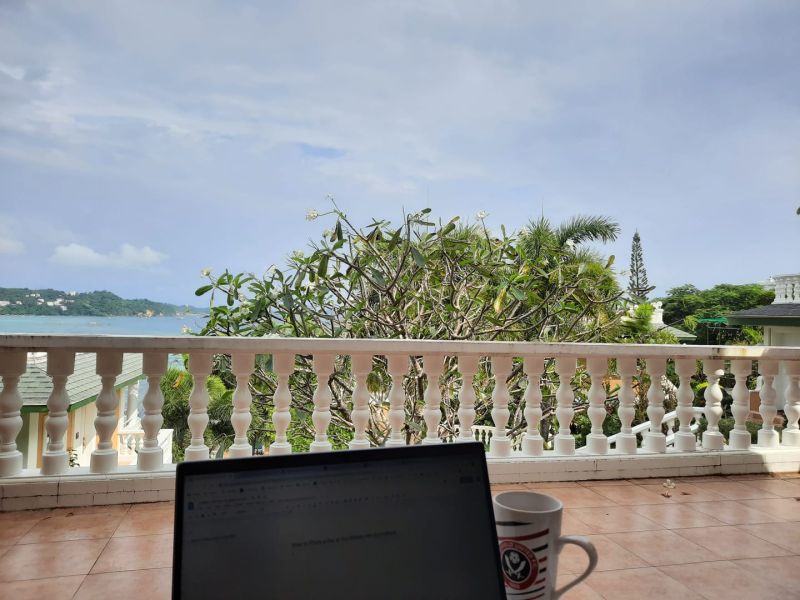
Cups of tea and inspiring views are great, but they’re not on my list of tips for new writers
In this post, I want to share a few tips for new writers. They might seem incredibly basic. You might dismiss them as obvious. Yet I see these errors time and time again.
Read the Brief
Before you begin, read the brief from start to finish. Once you start, refer to it multiple times throughout the process.
When you think the content is complete, read your brief again and make sure you’ve not missed anything. You’ll be amazed how many times something has slipped through the net.
Check Before Submitting
This one just screams “duh” and yet so many writers don’t bother to do it.
I’ve seen work submitted with half-written sentences that just trail off into nothingness. I’ve seen documents with blue squiggly lines everywhere, indicating obvious spelling errors.
If Word or Google is literally telling you “hey, there’s an error here” and you haven’t bothered to fix it, you’re definitely not getting any more writing jobsfrom that client. Proofread your work before submitting. Ideally, the next day with fresh eyes.
Disappearing
It’s never okay to miss a deadline *without communication*. Of course real life can surprise you. Sometimes deadlines can be missed due to a genuine emergency. However, all you need to do is message the client with an explanation *before* the deadline. They’ll understand. But they’re never going to trust you again if you just disappear and deliver late. Or worse, not at all.
Dominic Field iGaming Writer – My favourite Halloween-themed casino slots
With October just around the corner, I thought I’d share some of my favourite Halloween slots.
As an iGaming writer, I’m often asked to compile “best of” articles based on holidays, but I’ve never written anything about Halloween slots before. So, let’s put that right with a look at my three favourite games from this genre.
Blood Suckers Megaways (Red Tiger)
Reels x Rows
6 x 2-7
Paylines
Up to 117,649
RTP
97.66%
Volatility
High
Maximum Payout
20,521x
Release Date
January 2023
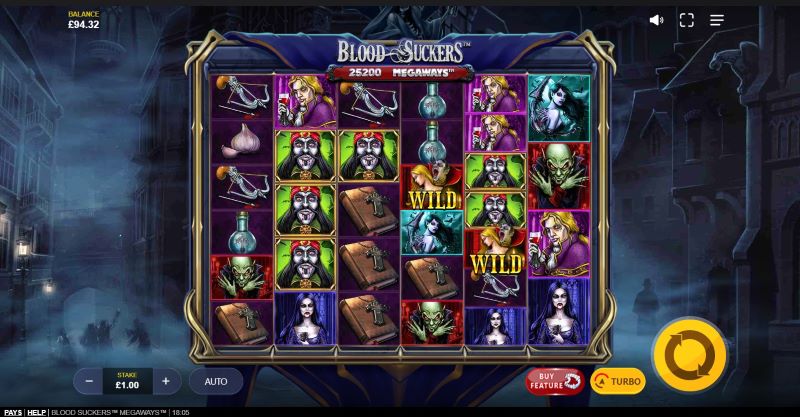
Blood Suckers Megaways slot: key information
No collection of spooky slots would be complete without a reference to Blood Suckers, released by NetEnt in 2009. It’s mostly famous for its staggeringly high Return To Player rate of 98.00%.
The thing is, though, it’s really dated and just not that interesting any more. However, when Red Tiger released a much-needed Megaways reboot in 2023, I was all over it.
Blood Suckers Megaways by Red Tiger is a more polished and engaging version than the original.
First of all, the graphics are much better. They’ve kept the original symbols, but polished them up a little, adding a few animations. The RTP of 97.66% is pretty close to the first release, too. But the dynamic Megaways engine makes it just that little bit more interesting.
Finally, as a fan of highly-volatile games, I’ve no problem with the variance here. Especially given the low new maximum potential payout of 20,521x.
Overall, it’s everything you want in a reboot. It stays true to the original, while adding several key improvements.
Big Bass Halloween 2 (Pragmatic Play)
Reels x Rows
5 x 3
Paylines
10
RTP
96.71%
Volatility
High
Maximum Payout
5,000x
Release Date
October 2024
Big Bass Halloween 2 slot: key information
I didn’t know this game was coming out until I saw a recent LinkedIn post about it. It’s honestly crazy how prolific the Reel Kingdom and Pragmatic Play partnership is. They just keep milking that poor fisherman dry, so it’s no surprise they’ve tried Halloween slots.
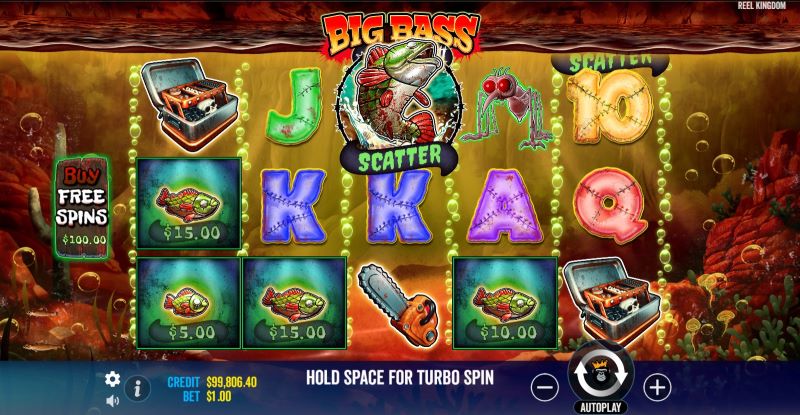
Like pretty much all of the Big Bass titles, Halloween 2 is yet another rehash of the same old mechanics. But, like the idiot that I am, I was drawn in by the new Texas Chainsaw Massacre-inspired theme.
Big Bass Halloween 2 by Reel Kingdom and Pragmatic Play has a Texas Chainsaw Massacre theme.
I’m also a sucker for witty puns, and we get off to a good start with the start screen. Our newly zombified angler friend tells us to “feel the buzz” as he wields his motorised bonecutter.
Apart from the fun theme and Halloween novelty value, there are some genuinely nice elements. For instance, the RTP is much better than the 96.04% offered by the first Big Bass Halloween title. As is the 5,000x maximum payout, improving on the original figure of 2,100x.
I’m not going to pretend it’s anything ground-breaking, because it isn’t. But not every game has to reinvent the wheel, and these Big Bass games are popular for a reason.
Mental (Nolimit City)
Reels x Rows
5 x 3
Paylines
1,024+
RTP
96.08%
Volatility
Very High
Maximum Payout
66,666x
Release Date
August 2021
Mental slot: key information
I wasn’t aware of Mental until a long time after its release, when I was asked to write about the best horror slots for AllSlotSites. It’s pretty bleak – exactly what we’ve come to expect from Nolimit City over the years – but an intriguing game, nonetheless.
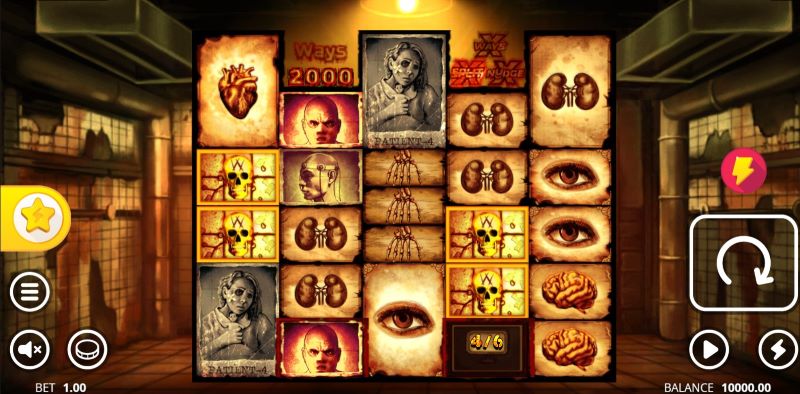
Clearly inspired by Dr Hannibal Lecter, the theme is one of a serial killer locked up in an institution. Look out for the grim Dead Patient feature, which plays on this motif while offering multipliers up to 9,999x.
Mental by Nolimit City is extremely dark and just a little terrifying.
The 3-2-3-2-3 reel layout was pretty unusual at the time, especially given that some of these symbols can split. That makes things extra interesting, creating more than 1,024 ways to win and ensuring that every spin is different.
Like all Nolimit City releases, the volatility is extremely high, setting up the possibility of some huge potential wins. I like the very specific top payout of 66,666x – a fitting figure for such a demonic game.
Need a Scarily Good Gambling Writer?
Looking for a writer that’s all treats and no tricks? Then contact me and let’s create some horrifyingly good slots content.
What? I couldn’t make it all the way through an article without a lazy Halloween cliché or two, now could I?!
Dominic Field is a freelance iGaming Writer based on the island of Boracay, in the Philippines.
I call myself an iGaming writer. However, when I first started freelancing, I used the term copywriter. But they’re not the same thing.
At first, I didn’t know the difference. I don’t mind admitting it. Now that I do, I see lots of people on LinkedIn making the same mistake.
So, what’s the difference between a copywriter and a content writer?
Copy or Content?
A copywriter is more of a salesperson than a regular content writer. The idea is to use words to capture people’s attention, trigger emotions and provoke their imagination. Ultimately, the intention is to convert a reader into a paying customer.
But you write casino reviews for iGaming affiliates. You’re selling a product. Isn’t that copywriting?
No, it isn’t.
When I write a casino review, I write an objective piece of text that lays out the negatives as well as the positives. Even if your client asks you for an insanely biased review, you’re still producing content, not sales copy.
What is Sales Copy?
I’m no expert in copywriting, so if you are, please forgive my clunky definition. But in my mind, copywriting is about producing short, sharp messages that urge a potential customer to act. It’s purely sales-driven and it addresses a specific need, often in an emotionally engaging way.
Content is more of an umbrella term. A piece of sales copy could certainly be described as “content”, but not all content is “copy”.
Content Builds Trust
As an iGaming writer, I produce lots of content that aims to build long-term trust with readers. Hence the importance of honesty when reviewing a gambling site like a casino or sportsbook.
Whether it’s a blog post, an ebook or text for a corporate website, the mission is usually to inform. These are the rules of Pot Limit Omaha. This is how to play blackjack optimally. These are our company’s values.
Sure, the client’s overall goal might be to drive readers towards opening a new casino account, or signing up to play online poker. But the purpose of my iGaming content is not usually to provoke someone into taking immediate action.
And that’s why you should call me a gambling writer, a content creator or anything other than a copywriter.
Overthinking. The art of creating problems that don’t actually exist. It’s certainly a problem I’ve struggled with in the past. Luckily, I had no such issues when creating my first portfolio as a freelance iGaming writer.
If you’re a new writer, you need a portfolio. But it doesn’t have to look great.
People spend far too much time worrying about what other people will think. They want everything to look and feel perfect. So, instead of just putting themselves out there, they do nothing. This isn’t good.
Something Beats Nothing
You don’t have to spend time and money on a pretty website. Prospective clients only need to see that you can write. They’re not looking for graphic designers. They’ll view the portfolio once, maybe twice, then it’ll be erased from their memories.
By putting out my ugly portfolio, thrown together in a simple Google Doc, I was able to acquire my first clients as a gambling writer. Once I’d earned a little money, I could then invest in a website and put together a proper portfolio.
Mind you, the showcase on my website is still pretty ugly. Something to add to my to-do list, I think.
What About Ghostwriting Portfolios?
After publishing that LinkedIn post, a fellow iGaming writer contacted me privately with a related dilemma.
He’s published more than 500 articles, but none with a byline. Everything he’s done has been as a ghostwriter. He was putting off making a portfolio for a long time, because he wasn’t sure how to approach it, and asked for my advice.
Just Do It – It’ll Be Fine
Well, from my experience, this is common in the world of gambling affiliates. You’re often ghostwriting, but without an official discussion ever taking place around who owns the work.
I see it like this. Unless you signed some kind of agreement that says you can’t claim credit for the work, there’s no harm linking to it in your portfolio.
If you want to be extra careful, ask the owner if it’s okay first. I can’t imagine too many cases where the client would say no. It’s been three-and-a-half years since I turned freelance, and nobody’s ever resisted when I’ve asked.
Your main issue is whether or not the prospective client will believe that you really wrote the articles, since there’s no credit. Well, if they don’t trust you, I’m not sure that’s a good platform on which to build a new working relationship anyway. Don’t lose any sleep over it.
Besides, if you really did write it, you’ll have no problem sending the original Word or Google doc to prove it.